Note
Access to this page requires authorization. You can try signing in or changing directories.
Access to this page requires authorization. You can try changing directories.
Note
Community interest groups have now moved from Yammer to Microsoft Viva Engage. To join a Viva Engage community and take part in the latest discussions, fill out the Request access to Finance and Operations Viva Engage Community form and choose the community you want to join.
This article provides information to help you get started with Electronic invoicing for Uruguay. It guides you through the configuration steps that are country/region-dependent in Microsoft Dynamics 365 Finance or Microsoft Dynamics 365 Supply Chain Management. These steps complement the steps that are described in Electronic invoicing setup. For the last-mile integration with the Uruguayan Tax Authorities, Microsoft is partnering with Edicom.
After you configure Electronic invoicing, you can generate, digitally sign, and submit the XML files of electronic invoices to the Edicom authorized certification provider (PAC) according to the regulatory requirements in Uruguay.

Note
The electronic invoicing approach that this article describes is implemented by using an invoicing service that is applicable only to cloud deployments of Finance or Supply Chain Management.
Prerequisites
Before you begin the procedures in this article, the following prerequisites must be met.
Ensure that the settings for the Uruguayan legal entity are in place. Learn more in Set up a legal entity and tax information for Uruguay.
Gain familiarity with and understanding of Electronic invoicing as it's described in Electronic invoicing overview.
Do the common part of Electronic Invoicing service configuration as described in Electronic invoicing configuration.
You must enable the following features in Feature management:
- Electronic invoicing integration
- Electronic invoicing integration resubmit document from failed action
- Execute update actions for submitted documents
Ensure that the following Electronic reporting (ER) format configurations are imported. Learn more in Import Electronic reporting (ER) configurations from Dataverse, and Import Electronic reporting (ER) configurations.
- Customer invoice context model
- Edicom response error log import
- Edicom Response Processing LATAM
- Edicom source file response import format
- Inventory e-Invoice (UY)
- Inventory Export e-Invoice (UY)
- e-Packing Slip (UY)
- Export e-Packing Slip (UY)
- Project e-Invoice (UY)
- Project Export e-Invoice (UY)
Note
These formats are based on the corresponding LATAM format configurations, which use the Invoice model LATAM and Invoice model mapping LATAM configurations. All other required configurations are imported automatically.
Configure the electronic invoicing feature
The "Uruguay Electronic Invoice (UY) Edicom integration for Uruguay" feature represents an outbound flow to issue the following sales documents.
| Name | Code | Original name |
|---|---|---|
| Electronic sales invoice | 111 | Factura electrónica de venta |
| Credit Note | 112 | Nota de Crédito |
| Debit Note | 113 | Nota de Débito |
| Packing Slip | 181 | Remito |
| Export invoice | 121 | Factura de exportación |
| Export Credit Note | 122 | Nota de Crédito de exportación |
| Export Debit Note | 123 | Nota de Débito de exportación |
| Export packing slip | 124 | Remito de exportación |
Some parameters of the feature are published with default values. Before you deploy the Electronic invoicing feature to the service environment, add a feature that is based on the Microsoft-provided feature, and complete the common parameters on the Feature parameters tab. Review the default values, and update them as required, so that they better reflect your business operations.
Edicom Interactions for Uruguay
For Uruguay, there are at least four core interactions with Edicom in the base flow:
- Invoice submission
- Signed XML retrieval
- Status retrieval of the submitted invoice
- Customer acceptance or rejection
Each of these interactions requires common parameters, such as Edicom connection details and the authentication token provided by Edicom. These parameters are reused across the feature setup for all document types. Edicom supplies these values during the company's onboarding process.
Uruguay Electronic Invoice (UY) Edicom integration for Uruguay
Important
The Uruguay Electronic Invoice (UY) feature is provided by Microsoft. Before it can be used, it requires additional configuration, as described in this article. Learn how to configure invoicing features and apply changes in Work with feature setups. For example, in addition to the connection parameters, you can filter specific legal entities so that they are processed in applicability rules. By default, the feature is applicable to all legal entities that have a primary address in Uruguay.
Import the latest version of the Uruguay Electronic Invoice (UY) Globalization feature as described in Import features from the repository. The following illustrations show what the feature looks like after you import it from Dataverse.

If you go to the Configuration tab, as shown in the previous screenshot, there's a page displaying information similar to the following table:
Name Version Status Country/region code Edicom Response Processing LATAM 13.2.5 Completed e-Packing Slip (UY) 296.140.89.125 Completed UY Export e-Packing Slip (UY) 296.140.89.41 Completed UY Inventory Export e-Invoice (UY) 296.140.89.52 Completed UY Inventory e-Invoice (UY) 296.140.89.64 Completed UY Project e-Invoice (UY) 296.139.40.39 Completed UY Note
The version numbers may change if the formats have been updated. The table is for illustrative purposes only.
Create a copy of the imported Globalization feature, and select your configuration provider. Learn more in Create a Globalization feature.
On the Versions tab, confirm that the Draft version is selected.
On the Feature parameters tab, specify values for the following connection and integration parameters that are required for interoperation with Edicom's API.
These parameters are general-purpose and are used across the different actions in the setups, so you only need to configure them once in this section.Tip
The following table provides example values for each feature parameter, so you can understand the type of data that should be entered for each one. These values are illustrative only and were provided by Edicom to Microsoft for testing purposes. When you are onboarded, Edicom provides you with your own unique values to use in your configuration.
Parameter Description Data type Value EdicomApplication Application String <ID_PROVIDED_EDICOM> EdicomDomain Domain String <ID_PROVIDED_EDICOM> EdicomGetStatusSchema Get status schema name String IN_DOCUMENT_STATUS_MICROSOFT_UY EdicomGroup Group String <GROUP_ID> EdicomSignedXMLSchema Signed XML schema name String EDIWIN-SOURCE-FILE_XML_CFE_ADENDA_<ID_PROVIDED_EDICOM> EdicomSubmitInvoiceDestination Destination name String <ID_PROVIDED_EDICOM>_EDIWIN EdicomSubmitInvoiceSchema Submit invoice schema name String OUTBOUND_DOCUMENT_MICROSOFT_UY EdicomToken Auth token Secret name EdiwinUruguayToken EdicomWebServiceURL Web service URL String https://ipaasgw.edicomgroup.com Tip
When configuring the feature parameters for Edicom integration, follow these steps:
- Select Application, and enter the service ID number you obtained from Edicom.
- Select Domain, and enter the same service ID number.
- Select Get status schema name, and enter the provided schema name.
- Select Group, and enter the group code you received.
- Select Signed XML schema name, and enter the appropriate schema name.
- Select Destination name, and enter the service ID number concatenated with "_EDIWIN". For example, if your service ID is 123456, enter 123456_EDIWIN.
- Select Submit invoice schema name, and enter the schema name.
- Select Auth token, and choose the name of the secret you created for the token.
- Select Web service URL, and verify the web address is correct.
The copy of the feature is always created as a Draft version. Regardless of whether you made changes, you must complete, publish, and deploy the feature as described in Complete and deploy a Globalization feature.
Outbound flow pipeline
There are six electronic invoice formats for Uruguay included in the Uruguay Electronic Invoice (UY) feature. Each format requires its own setup and configuration. The formats are:
- Inventory e-Invoice (UY)
- Inventory Export e-Invoice (UY)
- e-Packing Slip (UY)
- Export e-Packing Slip (UY)
- Project e-Invoice (UY)
- Project Export e-Invoice (UY)
The following sections have guidance on the general configuration steps that apply to all six formats. Specific considerations and requirements for each individual format are explained, so you can ensure that each one is configured correctly according to its unique needs.
Electronic invoice feature
Setups-View
After importing the feature, in the second screenshot, five tabs are available: Versions, Configuration, Feature parameters, Setups, and Tags. Select the Setups tab, and then select View. This opens the page Feature version setup:
Feature version setup
This page allows you to review and configure the details of the feature setup for Uruguay. On the left side of this page, there are four sections: Processing pipeline, Applicability rules, Variables, and Parameters.
Processing pipeline
The Setup Actions and Parameters section is divided into two distinct grids:
Top Right – Processing Pipeline
The Processing pipeline grid should is similar to the following table:
| Action | Action name | Description | Enable retry | Retry action | Export result | Update action |
|---|---|---|---|---|---|---|
| Transform document | Generate invoice XML file | |||||
| Integrate with Edicom | Submit invoice | |||||
| Get status from Edicom for an invoice | Get signed XML from Edicom | Checked | ||||
| Get status from Edicom for an invoice | Get invoice status from Edicom | |||||
| Process response | Process invoice status response | |||||
| Terminate pipeline | Terminate pipeline | Terminates the processing pipeline |
Note
The Get status from Edicom for an invoice action is crucial in the flow, as it is marked with the Update action checkbox. This designation means that this specific step—and all steps following it repeatedly execute in a loop. The system continues this process until the invoice reaches a final, terminal status, ensuring that the latest status from Edicom is always retrieved and processed.
Bottom Right – Parameters
The lower grid shows the Parameters associated with the selected processing action. These parameters allow for fine-tuning of the selected step’s behavior. Each entry includes a parameter name, description, data type, and value, enabling users to configure processing logic according to their business requirements.
Transform document parameters
| Name | Description | Value |
|---|---|---|
| Input file | Source file provides to the action the data to be executed. | Variable: BusinessDocumentDataModel |
| Direction | Direction describes which format will be used: import or export | export |
| Configuration | Configuration describes format which will be executed | Inventory e-Invoice: Inventory e-Invoice |
| Configuration Integration point | Source file provides data to the reporting runtime | InvoiceCustomer |
| Custom file name | Custom file name from the client |
Linking the correct format in Transform document parameters
When configuring the Transform document action in the processing pipeline, ensure the following:
Configuration: Set this to the exact name of the feature format you are configuring.
- For example:
Project e-Invoice (UY)→ Configuration:Project e-Invoice (UY)Inventory e-Invoice (UY)→ Configuration:Inventory e-Invoice (UY)Project Export e-Invoice (UY)→ Configuration:Project Export e-Invoice (UY)Inventory Export e-Invoice (UY)→ Configuration:Inventory Export e-Invoice (UY)e-Packing Slip (UY)→ Configuration:e-Packing Slip (UY)Export e-Packing Slip (UY)→ Configuration:Export e-Packing Slip (UY)
- For example:
Configuration Integration Point:
- Use
InvoiceCustomerfor inventory-related formats (Inventory e-Invoice (UY),Inventory Export e-Invoice (UY),e-Packing Slip (UY),Export e-Packing Slip (UY)). - Use
InvoiceProjectfor project-related formats (Project e-Invoice (UY),Project Export e-Invoice (UY)).
- Use
Tip
If the feature name contains "Project", use InvoiceProject. If it contains "Inventory", use InvoiceCustomer. Incorrect settings will result in empty XML or missing required data.
Integrate with Edicom parameters
| Name | Description | Value |
|---|---|---|
| Web service URL | URL address to send request | FeatureParameter: EdicomWebServiceURL |
| Http request body | Http request body (can be empty) | Generate invoice XML file: Output file |
| User name | KeyVault secret name to store user name | |
| Password | KeyVault secret name to store user password | |
| Client ID | Client ID secret name in the KeyVault | |
| Client Secret | Client Secret secret name in the KeyVault | |
| Auth token | Auth token secret name in the KeyVault | EdiwinUruguayToken |
| Domain | Domain | FeatureParameter: EdicomDomain |
| Application | Application | FeatureParameter: EdicomApplication |
| Destination | Destination | FeatureParameter: EdicomSubmitInvoiceDestination |
| Schema | Schema | FeatureParameter: EdicomSubmitInvoiceSchema |
| Duplicates | Duplicates | 0 |
| Group | Group | FeatureParameter: EdicomGroup |
| Custom file name | Custom file name from the client | Generate invoice XML file: File name |
Get signed XML from Edicom parameters
| Name | Description | Value |
|---|---|---|
| Web service URL | URL address to send request | FeatureParameter: EdicomWebServiceURL |
| User name | KeyVault secret name to store user name | |
| Password | KeyVault secret name to store user password | |
| Client ID | Client ID secret name in the KeyVault | |
| Client Secret | Client Secret secret name in the KeyVault | |
| Auth token | Auth token secret name in the KeyVault | EdiwinUruguayToken |
| Domain | Domain | FeatureParameter: EdicomDomain |
| Application | Application | FeatureParameter: EdicomApplication |
| Schema | Schema | FeatureParameter: EdicomSignedXMLSchema |
| Group | Group | FeatureParameter: EdicomGroup |
| ERP UUID | Reference Id of the document submitted to Edicom | Submit invoice: ExternalID |
Get invoice status from Edicom parameters
| Name | Description | Value |
|---|---|---|
| Web service URL | URL address to send request | FeatureParameter: EdicomWebServiceURL |
| User name | KeyVault secret name to store user name | |
| Password | KeyVault secret name to store user password | |
| Client ID | Client ID secret name in the KeyVault | |
| Client Secret | Client Secret secret name in the KeyVault | |
| Auth token | Auth token secret name in the KeyVault | EdiwinUruguayToken |
| Domain | Domain | FeatureParameter: EdicomDomain |
| Application | Application | FeatureParameter: EdicomApplication |
| Schema | Schema | FeatureParameter: EdicomGetStatusSchema |
| Group | Group | FeatureParameter: EdicomGroup |
| ERP UUID | Reference Id of the document submitted to Edicom | Submit invoice: ExternalID |
Process response parameters
| Name | Description | Value |
|---|---|---|
| Input file | Response to analyze | Get invoice status from Edicom: Output file |
| Reporting configuration list | List of configurations used for response parsing | Edicom Response Processing LATAM: Edicom Response Processing LATAM |
| Custom file name | Custom file name from the client | |
| Reporting configuration list | List of configurations used for response parsing | Edicom response error log import: Edicom response error log import |
Terminate pipeline parameters
| Name | Description | Value |
|---|---|---|
| Terminal state | Desired state of the pipeline when terminating | complete |
| Number of days | Number of days to wait before terminating | 8 |
Note
- If the status response indicates a failure, the pipeline is terminated, and the submission is marked as failed.
- If the response indicates successful submission to the Uruguayan Tax Authorities (DGI), the process will be completed after 8 days, provided no additional responses are received in the meantime.
Applicability Rules and Feature Setup Scope
Applicability rules must be correctly configured to provide context, so that the exact Electronic Invoicing Globalization feature that must run in the Electronic Invoicing service can be found. These applicability rules are provided out of the box by checking the legal entity’s International Organization for Standardization (ISO) country/region code.
Applicability rules for Uruguayan electronic invoice formats
Below are the applicability rules for each electronic invoice format for Uruguay. Replace <Legal Entity ID> with the actual ID of your legal entity.
Inventory UY
| And/or | And/or | Field | Operator type | Value | Data type |
|---|---|---|---|---|---|
| And | CountryISOCode | Equals | UY | string | |
| LegalEntityId | Equals | <Legal Entity ID> | string | ||
| Or | DocumentType | Equals | Customer invoice | string | |
| DocumentType | Equals | Customer credit note | string | ||
| DocumentType | Equals | Customer debit note | string |
Inventory Expo UY
| And/or | And/or | Field | Operator type | Value | Data type |
|---|---|---|---|---|---|
| And | CountryISOCode | Equals | UY | string | |
| LegalEntityId | Equals | <Legal Entity ID> | string | ||
| DocumentType | Equals | Export Customer invoice | string | ||
| DocumentType | Equals | Export Customer debit note | string | ||
| DocumentType | Equals | Export Customer credit note | string |
e-Packing Slip UY
| And/or | And/or | Field | Operator type | Value | Data type |
|---|---|---|---|---|---|
| And | CountryISOCode | Equals | UY | string | |
| LegalEntityId | Equals | <Legal Entity ID> | string | ||
| DocumentType | Equals | Customer packing slip | string |
Export e-Packing Slip UY
| And/or | And/or | Field | Operator type | Value | Data type |
|---|---|---|---|---|---|
| And | CountryISOCode | Equals | UY | string | |
| LegalEntityId | Equals | <Legal Entity ID> | string | ||
| DocumentType | Equals | Export Packing Slip | string |
Project UY
| And/or | And/or | Field | Operator type | Value | Data type |
|---|---|---|---|---|---|
| And | CountryISOCode | Equals | UY | string | |
| LegalEntityId | Equals | <Legal Entity ID> | string | ||
| Or | DocumentType | Equals | Project invoice | string | |
| DocumentType | Equals | Project credit note | string | ||
| DocumentType | Equals | Project debit note | string |
Project Expo UY
| And/or | And/or | Field | Operator type | Value | Data type |
|---|---|---|---|---|---|
| And | CountryISOCode | Equals | UY | string | |
| LegalEntityId | Equals | <Legal Entity ID> | string | ||
| DocumentType | Equals | Export Project invoice | string | ||
| DocumentType | Equals | Export Project credit note | string | ||
| DocumentType | Equals | Export Project debit note | string |
Variables
The following variables are used in the outbound data flow actions of the Uruguayan feature. (These variables are provided out of the box.)
- BusinessDocumentDataModel – The Business Document Data model variable that is received from Finance or Supply Chain Management and transformed into the format that is required for submission.
- SignedXML – The signed XML variable that is sent back to Finance or Supply Chain Management. This variable contains the base64-encoded response body from the Get Signed XML from Edicom step. It's used in the response types to save the signed XML that is obtained from Edicom as an attachment to the invoice journal. It's also used to generate printable reports through QR codes.
| Name | Description | Type | Data type | Value |
|---|---|---|---|---|
| BusinessDocumentDataModel | Contains the electronic document from the client | From client | file | |
| SignedXML | Signed XML document in base64-encoded format | To client | file | Get signed XML from Edicom.Base64ResponseBody |
After you import the Electronic invoicing for Uruguay feature that includes the out of the box default feature setup, follow the steps in the next section to configure electronic documents.
Setups-Application Setup
To configure the mapping between Dynamics 365 Finance source tables and electronic document formats, go to the Setups tab within the Electronic invoice feature section, and then select Application Setup. This step lets you define how data from Finance is linked to the correct electronic invoice formats for Uruguay.
Note
Although this configuration is not set at the general feature level, it acts globally for the selected feature setup. You don't need to repeat these steps for each individual format or feature—one configuration is sufficient for all supported document types within the feature.
The following grid defines the link between the source table in Dynamics 365 Finance, the document context model, and the mapping configuration used for electronic invoicing:
| Table name | Context model / Context | Electronic document mapping | Mapping name | Description |
|---|---|---|---|---|
| Customer invoice journal | Customer invoice context model / Customer invoice context | Invoice Model mapping LATAM | Customer E-Invoice | Maps customer invoices from the CustInvoiceJour table to the LATAM invoice model for electronic submission. |
| Project invoice | Customer invoice context model / Project invoice context | Invoice Model mapping LATAM | Project E-Invoice | Maps project invoices to the LATAM invoice model for electronic submission. |
Tip
Ensure that the Context and Mapping name match the document type. Incorrect mappings cause errors in XML generation or submission to DGI.
Configure electronic document parameters
To configure electronic document parameters, follow these steps:
- Make sure that the country/region-specific ER configurations for the document context and electronic document model mapping that are required for Uruguay are imported. Learn more in Set up Electronic document parameters.
- Go to Organization administration > Setup > Electronic document parameters.
- In the Electronic document section, add records for the Customer Invoice journal and Project invoice table names.
- For each table name, set the Document context and Electronic document model mapping fields in accordance with step 1.
The Electronic Document Parameters page in Dynamics 365 Finance. Shows on the left-hand navigation pane, we can see the following options:
Electronic Document
Features
Electronic Invoicing
Integration Channels
For the Electronic Document option on the right-hand side, the section labeled Electronic Reporting is displayed.
Within Electronic Reporting, a grid is presented which lists the electronic document configurations. This grid includes important associations between:
The source table name
The document context model and context
The electronic document model mapping
The final mapping name used for generating the electronic invoice.
This configuration is essential for determining how Dynamics 365 Finance maps internal data models to external electronic formats for submission to tax authorities or service providers.
Configure the grid as follows:
| Table name | Microsoft-owned | Document context model | Document context | Electronic document model mapping | Mapping name |
|---|---|---|---|---|---|
| Customer invoice journal | No | Customer invoice context model | Customer invoice context | Invoice Model mapping LATAM | Customer E-Invoice |
| Project invoice | No | Customer invoice context model | Project invoice context | Invoice Model mapping LATAM | Project E-Invoice |
Save your changes, and close the page.
For each table name, follow these steps:
Select Response types, select New to create a response type that you will get from the back end, and enter the following values:
- In the Response type field, enter SignedXML (the default value). (See the Variables section of this article.)
- In the Description field, enter any meaningful name. Alternatively, leave the field blank.
- In the Submission status field, select Pending.
- In the Model mapping field, select Edicom source file response format.
Repeat the preceding step, but set the Submission status field to Pending update actions execution. In this way, you can run a subset of the actions in the processing pipeline in a loop to continuously pull updated statuses and other information for the submitted documents from the tax authority. In the standard view, you should see a table similar to the following:
Response type Description Submission status Data entity name Model mapping SignedXML Signed XML obtained from EDICOM Pending Edicom source file response import format SignedXML Signed XML obtained from EDICOM Pending update actions execution Edicom source file response import format Note
The response includes the signed XML that is obtained from Edicom. This signed XML is stored in the system as an attachment to the corresponding invoice journal. It will eventually be used to generate printable invoices through QR codes.
Issue electronic invoices
After you complete all the required configuration steps, you can generate and submit electronic invoices for posted invoices by going to Organization administration > Periodic > Electronic documents > Submit electronic documents. For more information about how to generate electronic invoices, see Submit electronic documents.
To inquire about the results of a submission, go to Organization administration > Periodic > Electronic documents > Electronic document submission log, and select the required document type. For more information, see Work with Electronic document submission log.
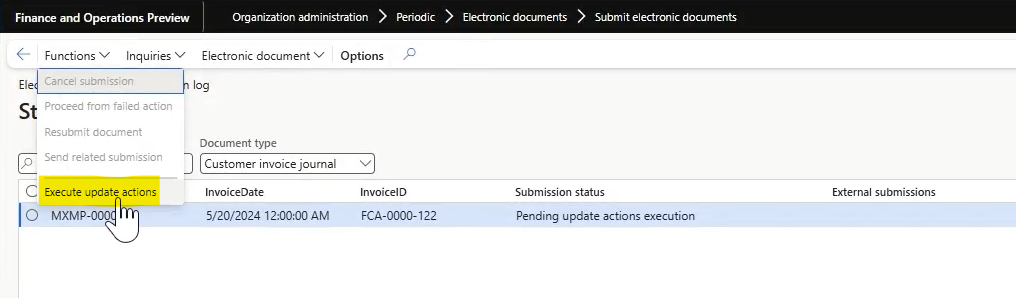
For Uruguay, after you submit the invoice, the submission status is set to Pending update actions execution. The response body is probably empty for the signed XML and the call to get the invoice status. An empty response body indicates that the XML wasn't available immediately after submission. To address the pending status, a function that is named Execute update actions is used. This function resumes the pipeline from the action that is marked as an update action. It then runs all subsequent actions in the pipeline in a loop. The status should change to Executing again. Then, after a few seconds, it reverts to Pending update actions execution.
Note
By setting a recurrence schedule, you can configure the Execute update actions function to run in batch mode on a periodic basis.
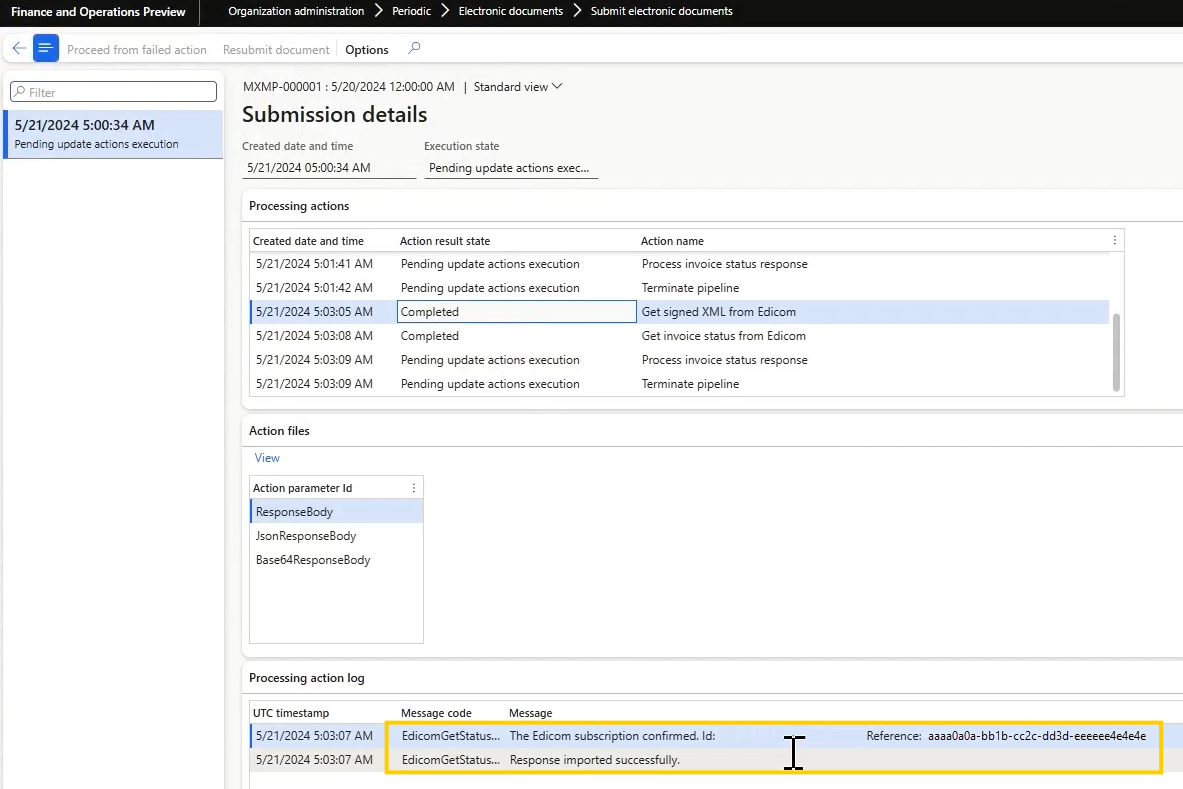
When you review the submission details, you should notice that the steps run again. This time, the signed XML is received.
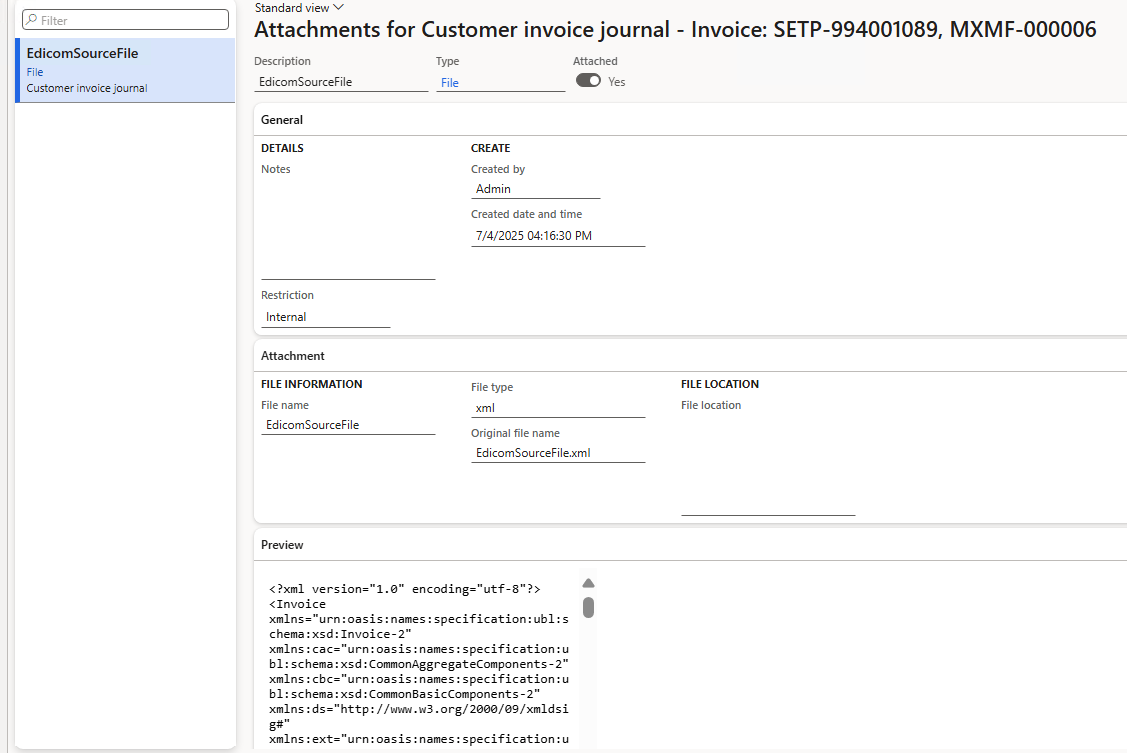
As a result of the completed outbound flow, the signed XML is attached to the invoice journal as EdicomSourceFile.
For Uruguay, the Process response action completes the pipeline after a few minutes.