Note
Access to this page requires authorization. You can try signing in or changing directories.
Access to this page requires authorization. You can try changing directories.
This reference architecture shows how to use Microsoft Fabric Real-Time Intelligence to build comprehensive wind farm maintenance solutions that handle real-time data from hundreds or thousands of wind turbines. You can process real-time telemetry data, weather conditions, and equipment performance metrics to enable intelligent wind farm operations with predictive analytics and real-time decision making.
You can manage large-scale wind farms where hundreds or thousands of wind turbines stream real-time data on performance metrics, operational state, and environmental conditions. The architecture integrates weather monitoring data through MQTT streaming and maintains comprehensive metadata and asset information on various types of turbine equipment to create a unified wind farm platform.
Architecture overview
The wind farm maintenance reference architecture uses Microsoft Fabric Real-Time Intelligence to create a unified platform that processes real-time data from wind turbines and integrates weather monitoring data for intelligent maintenance management. You can implement the architecture with four main operational phases: Ingest and process, Analyze, transform and enrich, Train, and Visualize and activate.
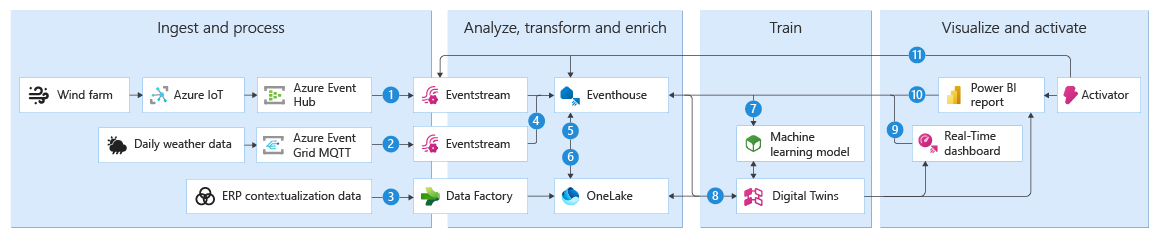
IoT events from wind turbines are transmitted with sub-second latency through Azure Event Hubs to Eventstreams.
Regional weather monitoring devices provide real-time data on wind speed, direction, temperature, and humidity. These devices send data to an MQTT broker, and Eventstream subsequently gathers the data.
Data Factory synchronizes asset metadata, including rotor blade generators, from the ERP system to OneLake.
Incoming telemetry is directed to Eventhouse, where the system processes vast amounts of data in sub-latency seconds. This processing aids in uncovering turbine related insights.
The system enhances and contextualizes turbine data by using asset metadata. This process results in organized tables that are ready for straightforward access.
The system establishes shortcuts in OneLake for maintaining long-term aggregated logs.
The system trains and evaluates advanced machine learning models in real time, facilitating the detection and prediction of maintenance issues.
Our ontology is defined by entities and semantic relationships that utilize aggregated data from OneLake to create a unified and digital representation of physical assets.
Real-Time Dashboard provides a high granularity view of all incoming telemetry with easy correlation to the asset trends.
Power BI generates high level reports providing yearly and monthly view on power generation and other business insights.
Activator is triggered to generate real time notifications on anomalies.
The following sections explain each operational phase in detail.
Operational phases
Ingest and process
Ingest real-time telemetry data from wind turbines from various sources and process it by using Eventstreams. Integrate weather monitoring data in real time through MQTT-Eventstream, delivering continuous environmental condition updates. This seamless data integration provides a comprehensive view of turbine performance, enabling operational optimization and predictive analytics.
- Operational state and vibration patterns
- Power generation metrics
- Environmental condition correlations
- Maintenance and service history
- Rotor blade and generator performance baselines
- Grid connection and energy output data
- Predictive analytics for maintenance optimization
- Historical trends for operational efficiency
Collect and update metadata and asset information on the various types of wind turbine equipment daily into OneLake, including:
- Rotor blade generator specifications and performance baselines
- Turbine installation locations and grid connections
- Maintenance history and service schedules
- Hardware configurations and sensor placements
A major wind farm operator with 2,000 wind turbines across multiple regions processes over 1 million telemetry events per day. These events include rotor speed readings, generator performance data, vibration measurements, power output metrics, and environmental sensor data. The MQTT-Eventstream integration processes this data while maintaining subsecond latency for critical maintenance decisions and operational optimization.
Analyze, transform, and enrich
Continuous transformations take place within Eventhouse, where real-time telemetry data from wind turbines is enriched with asset metadata stored in OneLake. This enrichment process creates fully curated, ready-for-consumption data by combining telemetry with the following information:
Turbine specifications - Rotor blade and generator performance baselines help you compare real-time telemetry against expected operational benchmarks. These baselines help you identify deviations that may indicate potential problems or inefficiencies.
Location context - Installation sites and environmental conditions, such as altitude, terrain, and proximity to other turbines, provide a comprehensive understanding of how location impacts turbine performance and maintenance needs.
Historical patterns - Long-term performance trends and operational benchmarks help you detect anomalies, predict future performance, and identify opportunities for optimization based on historical data.
Maintenance records - Service history and scheduled activities ensure that maintenance plans align with current operational conditions and help you track the effectiveness of past maintenance efforts.
Weather analytics - Correlation of telemetry with real-time environmental data, such as wind speed, direction, and temperature, enables dynamic adjustments to turbine operations for optimal performance under varying weather conditions.
By correlating aggregated telemetry data with weather conditions, you get a curated view of performance patterns and operational efficiency. This real-time processing provides the following capabilities:
Performance optimization - Immediate calculations for turbine efficiency and power generation adjustments ensure that turbines operate at peak performance, maximizing energy output and reducing wear and tear.
Trend analysis - Identification of peak performance patterns and energy demand forecasting helps operators plan for high-demand periods and optimize energy distribution strategies.
Predictive maintenance - Optimized scheduling and resource allocation based on operational insights reduce downtime and maintenance costs by addressing potential problems before they escalate into failures.
Environmental impact analysis - Correlation of weather conditions with turbine performance allows for adaptive operations that minimize environmental impact while maintaining energy efficiency. For example, adjusting turbine speeds during extreme weather events reduces stress on components.
Train
Build, train, and score machine learning models in real time by using Data Science capabilities to predict maintenance needs and turbine performance. These models continuously learn from incoming telemetry data, weather conditions, and historical performance patterns to provide actionable insights for wind farm operations. Key predictive capabilities include:
Maintenance prediction models - Use advanced machine learning algorithms to forecast potential equipment failures by analyzing historical maintenance records, real-time telemetry, and environmental conditions. These models enable proactive scheduling of service activities, reducing downtime and extending the lifespan of critical components.
Performance optimization - Leverage predictive analytics to determine the optimal operational settings for turbines based on real-time weather data, such as wind speed, direction, and temperature. This approach ensures maximum energy output while minimizing wear and tear on turbine components.
Power generation forecasting - Employ machine learning models to predict energy output under varying weather conditions and operational scenarios. These forecasts help operators plan grid integration, manage energy distribution, and optimize power trading strategies.
Environmental impact optimization - Analyze weather patterns and operational data to identify strategies that minimize the environmental impact of wind farm operations. For example, adjust turbine speeds during extreme weather events to reduce stress on components and mitigate noise pollution.
Asset lifecycle management - Utilize predictive models to monitor equipment degradation patterns and anticipate replacement needs. This approach supports long-term planning for asset upgrades, ensuring cost-effective maintenance and sustained operational efficiency.
Visualize and activate
Activator in Fabric Real-Time Intelligence generates real-time notifications to maintenance teams for wind turbine malfunctions and anomalous behavior. By using this real-time awareness and automated responses, the system reduces manual intervention and helps prevent delays in addressing critical issues. Key alerting capabilities include:
Immediate fault response - Automatic alerts for turbine malfunctions or performance degradation, such as abnormal vibration patterns, overheating, or unexpected power output drops. These alerts enable maintenance teams to quickly identify and address problems, minimizing downtime and preventing further damage to critical components.
Proactive maintenance - Preventive notifications are generated based on predictive analytics, which analyze historical data, real-time telemetry, and environmental conditions. For example, alerts can be triggered when a turbine's rotor blade shows signs of wear or when generator performance deviates from expected baselines, allowing operators to schedule maintenance before failures occur.
Performance optimization - Real-time adjustments are made to optimize farm efficiency and power generation. For instance, turbines can be dynamically reconfigured to adjust blade angles or rotational speeds based on wind conditions, ensuring maximum energy output while reducing mechanical stress and wear.
Safety alerts - Immediate notifications are sent for safety-critical problems requiring urgent response, such as extreme weather conditions, structural integrity concerns, or electrical faults. These alerts ensure that operators can take swift action to shut down turbines, secure the site, or deploy emergency response teams to protect personnel and equipment.
Your wind farm operations teams use Power BI dashboards connected directly to Eventhouse and OneLake to monitor live turbine performance, maintenance trends, and energy generation through unified analytical views, including:
Performance analytics - Generate detailed reports on power generation patterns, including comparisons across different regions, turbines, and time periods. For example, analyze seasonal variations in energy output to identify trends and optimize turbine operations during peak demand periods.
Revenue analysis - Track financial performance by correlating power generation data with energy market prices. For instance, evaluate the profitability of turbines operating in high-demand regions and identify opportunities to maximize revenue through dynamic energy trading strategies.
Maintenance performance - Measure operational efficiency by analyzing equipment availability and downtime metrics. For example, assess the impact of predictive maintenance schedules on reducing unplanned outages and improving overall turbine reliability.
Predictive insights - Provide forecasting reports for maintenance planning and capacity optimization. For instance, predict the likelihood of turbine component failures based on historical performance data and environmental conditions, enabling proactive resource allocation and minimizing operational disruptions.
Real-Time Dashboard provides live operational visibility with customizable views for different operational roles, enabling teams to monitor and respond to real-time events effectively. These dashboards provide the following capabilities:
Farm overview - Provides a comprehensive view of all wind turbines in the wind farm, including their real-time operational status, performance metrics, and any active alerts. This high-level overview enables operators to quickly assess the overall health and efficiency of the wind farm.
Turbine-level monitoring - Offers detailed insights into the performance and efficiency of individual turbines. Operators can monitor specific metrics such as rotor speed, power output, vibration patterns, and environmental conditions affecting each turbine.
Component-level details - Enables granular monitoring of critical turbine components, including rotor blades, generators, and sensors. This level of detail helps identify potential problems at the component level, such as wear and tear, misalignment, or sensor malfunctions, allowing for targeted maintenance actions.
Operational metrics - Displays real-time key performance indicators (KPIs) for the wind farm, such as overall efficiency, total power generation, maintenance status, and energy output trends. These metrics provide actionable insights for optimizing operations and ensuring the wind farm meets its performance goals.
KQL Copilot enables you to use natural language queries to quickly check the status of wind turbines, identify potential operational problems, and explore real-time data without requiring complex coding. Additionally, you can train KQL Copilot to aggregate and evaluate turbine performance patterns, providing deeper operational insights for optimizing turbine efficiency and wind farm performance.
Technical benefits and outcomes
The wind farm maintenance reference architecture delivers measurable technical and operational benefits by combining real-time data processing, predictive analytics, and automated workflows across turbine operations, asset management, and maintenance systems.
Wind farm intelligence
Real-time farm monitoring - Monitor hundreds or thousands of wind turbines with subsecond response times for critical maintenance operations.
Predictive analytics - Use ML models to forecast maintenance needs, performance optimization, and power generation patterns.
Unified data platform - Integrate turbine data with weather conditions and asset information for comprehensive farm management.
Granular visibility - Drill-down capabilities from farm overview to individual turbine components.
Automated maintenance operations
Intelligent alerting - Real-time notifications to maintenance teams for equipment malfunctions and anomalous behavior.
Automated workflows - Set up triggers for maintenance scheduling, performance optimization, and safety alerts.
Proactive farm management - Use predictive models for equipment availability and performance optimization.
Dynamic resource allocation - Enable real-time adjustments to maintenance schedules, power generation, and operational strategies.
Advanced analytics and business intelligence
Real-time performance optimization - Correlate turbine data with weather conditions for immediate efficiency calculations and operational strategies.
Rich BI capabilities - High granularity business analysis with direct query on real-time turbine data.
Natural language processing - Query complex wind farm data using conversational AI.
Cross-system correlation - Link real-time events with historical patterns and asset information.
Operational efficiency and power generation optimization
Predictive maintenance - Reduce downtime and maintenance costs through ML-driven failure prediction.
Performance optimization - Maximize power generation and efficiency through weather-based forecasting and dynamic adjustments.
Farm performance - Enhance operational efficiency through real-time monitoring and performance analytics.
Cost management - Optimize maintenance costs through predictive scheduling and resource allocation.
Implementation considerations
Data architecture requirements
High-throughput ingestion - Design your system to process millions of turbine telemetry events daily from hundreds or thousands of wind turbines, with burst capacity during severe weather events.
Real-time processing - Ensure subsecond response times for turbine safety alerts, under two-second response for performance updates, and under five-second processing for maintenance calculations.
Data quality and validation - Implement real-time validation for turbine identification, performance metrics, weather correlation data, and maintenance calculations with automatic error correction.
Scalability planning - Design your architecture to handle growing wind farms with more than 5,000 turbines, seasonal weather variations, and rapid farm expansion.
Storage requirements - Plan for 50 to 500 TB of turbine data per month for large farms, with five-year retention for performance analytics, and hot storage for the last two years of operational data.
Weather integration - Seamless integration with weather monitoring systems for real-time environmental data and forecasting.
Security and compliance
Data encryption - Implement end-to-end encryption for sensitive turbine data, operational information, and maintenance records by using industry-standard algorithms (AES-256). Encrypt data at rest and in transit, and maintain separate encryption keys for operational and maintenance data.
Access controls - Implement role-based access control aligned with operational responsibilities (farm operators, maintenance technicians, safety teams, performance analysts), multifactor authentication for all system access, and privileged access management for administrative functions.
Audit trails - Create comprehensive logging for regulatory compliance including all turbine operations, maintenance activities, and system modifications by using immutable audit logs and automated compliance reporting.
Data privacy - Ensure compliance with regional energy regulations and wind farm specific requirements for operational data and performance information protection.
Integration points
Wind turbine management: Integrate with turbine hardware, SCADA systems, and maintenance platforms by using industry-standard APIs and protocols.
MQTT weather providers: Integrate in real time with weather monitoring systems, meteorological services, and environmental monitoring platforms for dynamic weather data.
Grid systems: Integrate with power grid management, energy trading platforms, and utility systems for seamless power delivery.
External data sources: Use APIs for grid conditions, energy demand forecasting, environmental compliance systems, and regulatory reporting platforms.
Monitoring and observability
Operational monitoring:
System health dashboards: Use real-time monitoring of MQTT-Eventstream integration for weather data, turbine telemetry throughput, and Activator notification delivery with automated alerting for system anomalies.
Data quality monitoring: Continuously validate incoming turbine data with alerting for turbine communication failures, invalid performance metrics, or corrupted weather data.
Performance metrics: Track data ingestion latency from turbines, query response times for Real-Time Dashboards, and ML model prediction accuracy with SLA monitoring.
Cost optimization:
Capacity management: Right-size Fabric capacity based on wind farm size and data volume. Implement autoscaling for severe weather periods, and cost optimization during low-activity periods.
Data lifecycle management: Automate archival of older turbine data to lower-cost storage tiers. Align retention policies with business and regulatory requirements, and delete non-essential telemetry data.
Performance cost optimization: Correlate performance patterns with weather conditions in real time to minimize operational costs and maximize power generation.
Next steps
Getting started
Phase 1: Foundation setup
Review Microsoft Fabric Real-Time Intelligence capabilities and understand capacity requirements for your wind farm scale (hundreds or thousands of turbines).
Plan your MQTT-Eventstream integration strategy for both turbine telemetry and weather monitoring data. Start with critical data like turbine status, performance metrics, and safety parameters.
Design your real-time analytics implementation in Eventhouse for processing turbine events with subsecond latency requirements.
Configure OneLake for turbine asset metadata and historical data storage with appropriate retention policies.
Phase 2: Pilot implementation
Use a regional wind farm subset (50-200 turbines) to validate the architecture and MQTT integration performance.
Implement core data flows for turbine monitoring, performance tracking, and basic alerting capabilities.
Establish integration with weather monitoring providers and asset management systems for real-time correlation.
Deploy Real-Time Dashboard for wind farm monitoring with drill-down capabilities from farm overview to individual turbine components.
Phase 3: Operational validation
Test system performance during severe weather conditions and high-activity scenarios.
Validate Activator rules for maintenance team notifications based on equipment malfunctions and anomalous turbine behavior.
Ensure compliance with energy regulations and grid integration requirements.
Train your operational teams on dashboard usage, alert management, and drill-down analysis procedures from farm to component level.
Advanced implementation
Intelligent automation and AI
Set up advanced Data Science capabilities for building, training, and scoring predictive ML models for maintenance prediction and performance optimization.
Implement Activator for sophisticated wind farm automation including predictive maintenance, dynamic performance optimization, and automated maintenance dispatch.
Deploy Copilot for natural language analytics. Enable your teams to query complex scenarios like "Show me all turbines with performance problems during high wind conditions in the northern region".
Create intelligent wind farm systems that provide real-time decision support based on performance patterns, weather conditions, and maintenance requirements.
Enterprise-scale deployment
Scale to full wind farm operations with thousands of turbines and centralized monitoring across multiple regions.
Implement advanced analytics for power generation forecasting, maintenance optimization, and grid integration.
Create comprehensive dashboards with Power BI direct query capabilities and Real-Time Dashboard for executive reporting, operational monitoring, and regulatory compliance.
Develop enterprise-grade machine learning models for maintenance prediction, performance optimization, and farm expansion planning.